
How Illinois Pays for Adult Day Service: The Community Care Program, a $16.84 Hour Rising to $17.84, and Two Ways to Get Paid
Illinois pays adult day service at $16.84 an hour under the Community Care Program — $17.84 from January 1, 2027 — from the Department on Aging or the participant's HealthChoice plan. Eligibility, certification, both billing paths, and IDoA reviews.
Watch the video walkthrough
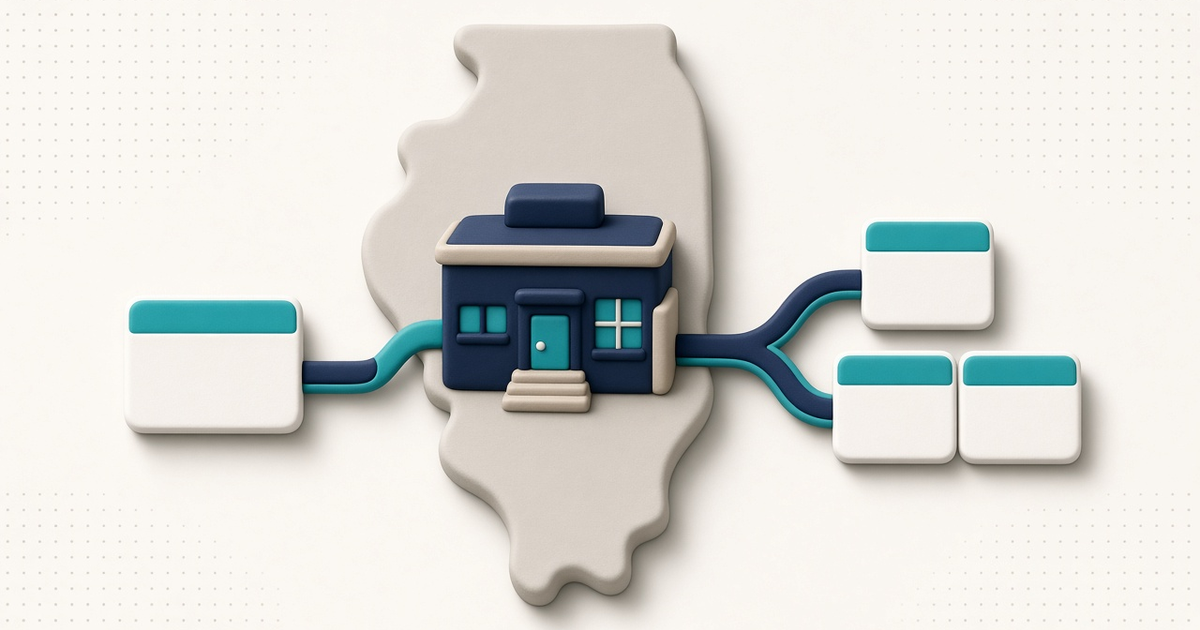
Illinois pays for adult day service through the Community Care Program, and an operator has to understand two things at once: what the state pays, and who pays it. The rate is set in statute — $16.84 an hour and $12.44 per one-way trip since January 1, 2024, rising to $17.84 and $13.44 on January 1, 2027 under a law signed this June. The payer depends on the participant: the Department on Aging for state-funded and fee-for-service Medicaid participants, or the participant's HealthChoice Illinois plan for the rest. In fiscal 2025, IDoA contracted with 73 adult day sites and paid for about 1,356 participants a month, while more than 55,000 Community Care participants received their services through a managed care plan. Here is how the program is built, how a center gets certified, and how each of the two billing paths works.
ElderSuite serves adult day care centers nationwide. This piece is Illinois-specific — adult day service for participants 60 and older under the Community Care Program, not the Home Services Program for younger adults or developmental training.
One program, two funding streams
The Community Care Program exists under 20 ILCS 105/4.02 to “prevent unnecessary institutionalization of persons age 60 and older,” and adult day services is one of its named services. Eligibility under 89 Ill. Adm. Code 240: age 60 or older; a Determination of Need score of at least 29, with 15 of those points on Total Impairment; and non-exempt assets of $17,500 or less. Applicants must apply for Medicaid, but they do not have to qualify — those who do are served under the Persons who are Elderly waiver, and those who do not are served with state funds. The services are identical either way. About 75 percent of CCP participants are Medicaid waiver customers.
The waiver itself, IL.0143, is at a hinge. Its current term ends September 30, 2026, and HFS proposed a five-year renewal effective October 1, 2026 with comment through June 20; CMS approval had not been posted as of this writing. The renewal also retires the Medicare-Medicaid Alignment Initiative, which ended December 31, 2025, in favor of fully integrated dual-eligible special needs plans.
Adult day service as Illinois defines it
Section 240.230 defines adult day service as “the direct care and supervision of adults aged 60 and over in a community-based setting for the purpose of providing personal attention and promoting social, physical and emotional well-being in a structured setting,” delivered under an ADS Addendum to the participant's person-centered plan of care, which must be established “not later than the fourth week of service.” Required components include health-related services — health monitoring, moderate or intermittent nursing intervention, medication administration or supervision — a daily meal providing at least a third of the Dietary Reference Intakes plus snacks, and transportation provided or arranged with at least one physically accessible vehicle. Ancillary services are not reimbursed inside the unit rate.
The unit is the hour: “one direct participant contact hour (excluding transportation time),” meaning “60 consecutive minutes of active programming,” billed in quarter-unit increments. Transportation is a separate unit — one one-way trip between the center and the participant's home — capped at two per participant per day.
Certified, not licensed
Illinois does not license adult day service. IDoA certifies it, and Section 240.1520 says the Department buys CCP services “only from providers certified by the Department.” Certification is an open, rolling, any-willing-and-qualified process — IDoA's certification page describes seven steps from application through IMPACT enrollment and contracting — with a separate application for each site. Certification runs no more than three years, Provider Agreements are “generally for a three-year period,” and recertification requires a performance review first. A prospective adult day provider needs two years of direct social services programming experience, proof of assets sufficient to cover 90 days of operating expenses, five references, and general liability coverage of $1 million per occurrence and $3 million aggregate.
The staffing rules are a table, not a ratio. Under Section 240.1555, a program needs two staff for one to twelve participants, three for 13 to 20, four for 21 to 28, five for 29 to 35, six for 36 to 45, and one more for every seven beyond that — counting only staff who spend at least half their time in on-site direct service or supervision. Every employee completes 26 hours of pre-service training in the first week, two of them on dementia, and 14 hours of in-service training a year; at least two staff are CPR-certified and first-aid trained, with one on site whenever participants are present. Under Section 240.1560, the program nurse is an RN, or an LPN supervised by an RN, on duty at least half of a full-time work period each day participants attend, and the program coordinator is on duty full time. The facility standards in Section 240.1550 add 40 square feet of activity area per participant, a room temperature between 70 and 85 degrees, an accessible bathroom for every twelve participants, dietitian-approved menus planned four weeks ahead, and quarterly fire drills.
The rate, and the raise coming January 1
IDoA's fee schedule pays adult day service at $16.84 per hour (S5100) and adult day transportation at $12.44 per one-way trip (T2003), statewide, with no geographic adjustment. Both figures are written into the statute, effective January 1, 2024; before that the rate was $15.30 and $11.29 from 2022, and $14.30 and $10.29 in 2021.
On June 16, 2026 the Governor signed P.A. 104-470, the FY2027 Medicaid omnibus, which added a new sentence to Section 4.02: “Beginning January 1, 2027, subject to any necessary federal approval, rates for adult day services shall be increased to $17.84 per hour and rates for each way transportation services for adult day services shall be increased to $13.44 per unit transportation.” That is the first adult day rate change since 2024. The “federal approval” clause matters: the May 2026 renewal draft still lists $16.84, so a waiver amendment will have to carry the new figure to CMS. IDoA is also running a rate study of all CCP services, and its advisory committee had “Waiver Renewal Status & ADS rate increases” on its August 11, 2026 agenda.
Two ways to get paid
When IDoA pays. For state-funded participants and fee-for-service Medicaid participants, the provider submits an electronic Vendor Request for Payment to the Department “no later than the 15th day of the month following the month in which services were provided,” stating the units delivered to each participant. IDoA's billing system checks every line against the authorization in the case management system and rejects any bill for a participant who is enrolled in a managed care plan, directing the provider to bill the plan instead. Payment comes from the State Comptroller, and the State Prompt Payment Act adds one percent interest per month on any proper bill unpaid after 90 days. In February 2026 IDoA told its advisory committee that general-revenue payments were running about three weeks behind.
When the plan pays. Medicaid participants enrolled in HealthChoice Illinois — Aetna Better Health, Blue Cross Community Health Plans, Meridian, and Molina statewide, plus CountyCare in Cook County, per HFS's January 2026 managed care map — get their adult day service paid by the plan. Dual-eligible participants moved on January 1, 2026 from MMAI to a FIDE SNP (Aetna, Humana, Molina, or Wellcare/Meridian), and HFS's provider notices say providers must contract with each plan individually. The HealthChoice Illinois model contract gives adult day providers real protections: every plan must contract with any willing and qualified waiver provider that accepts its rate, must pay HCBS waiver providers “at a rate no less than the rate in effect for the Department,” must pay 90 percent of clean claims within 30 days and 99 percent within 90, and must contract with enough adult day providers to cover 80 percent of prior participants in each county. Timely filing is set plan by plan.
Electronic claims go out as 837P files, and all five HealthChoice Illinois plans — Aetna Better Health Illinois (payer ID 26337), Blue Cross Community Health Plans (MCDIL), CountyCare (06541), Meridian Health Plan Illinois (MHPIL), and Molina Healthcare Illinois (20934) — are available payers for batch claims on the Availity clearinghouse, the same clearinghouse ElderSuite submits claims through. That means an Illinois center can run the plan side of the pipeline in one system: daily attendance becomes service documentation, documentation becomes claims, and claims go out electronically. Availity requires a one-time payer enrollment before the first claim goes out. For the full workflow from attendance record to electronic claim, see ElderSuite's Medicaid billing guide.
One thing you do not need: electronic visit verification. Illinois' EVV requirement covers personal care in the home; Part 240 applies it to in-home service providers, and IDoA's March 2026 integration with the state's EVV system was for in-home providers only.
The records IDoA reviews
Under Section 240.1520, providers keep billing and payment records “plus the underlying documentation to support the units of service submitted to the Department for reimbursement” for at least six years. Section 240.1550 requires medication administration to be recorded in the participant's case record, physician orders on file, and an emergency contact and recent photograph for each participant; critical events are reported in the Department's system within seven days. IDoA conducts a quality-improvement desk review of every contracted provider at least once per three-year contract cycle, pulling a minimum of five customer files and checking “that billing submitted to the OA by the provider matches what the customer acknowledged for provision of service” — any billing error requires the provider to submit negative billings. The Department may also run a performance review at any time, and three consecutive non-compliant reviews can end the Provider Agreement.
Because the unit is an hour of direct contact and the transportation unit is a trip, the record that survives review is the one that shows arrival and departure times and each one-way ride. Your attendance tracking is the first document a reviewer will open — and, on the plan side, the document the plan's own claims validation checks against.
Where to check
- IDoA's Community Care Program page, current rates, and certification process
- 89 Ill. Adm. Code 240 (adult day service at 240.230; provider standards at 240.1505–240.1660) and 20 ILCS 105/4.02
- HFS's Persons who are Elderly waiver page, managed care contracts, and MMAI-to-FIDE SNP transition page
- IDoA's FY2025 annual report
Follow ElderSuite in Google
Add ElderSuite as a Preferred Source to help Google show you more of our adult day care articles, industry updates, and resources.
ElderSuite keeps Illinois attendance hours, transportation trips, and plan claims audit-ready in one system.
ElderSuite is adult day care software for attendance, Medicaid billing, nursing documentation, and CACFP. You can try it free for 30 days.
Start a Free Trial
